Marketing roles and responsibilities have changed dramatically in the last decade, and the mix of people you need on your marketing team is very different than it was in the past. There are new roles and skill sets, new technologies, new mindsets and biases. When CEOs complain about their marketing department, I’ve found it’s not necessarily that the individuals on the team are incompetent. More often, it’s because the marketing team doesn’t have the right mix of skills required to achieve the CEO’s goals, which are often driven by revenue.
>> Related: Driving Sales and Marketing Alignment During Planning <<
At my previous company, we fumbled in the dark to build out the marketing team we needed to grow from $10 million to $40 million in revenue by making a lot of mistakes. We hired the wrong people and had to let them go after too much time had passed. When I talk to other marketing leaders, they have similar stories.
In this post, I’ll share a team structure that has worked for me in the past – including roles, responsibilities, org chart, and lessons learned on what not to do. Of course, this certainly isn’t the only way to structure your marketing team, but I hope it will provide visibility into the capabilities you need, regardless of how they’re organized.
In this post:
Sample B2B Marketing Org Chart
Here’s the org chart I’d use if I were starting a new marketing team today from scratch.
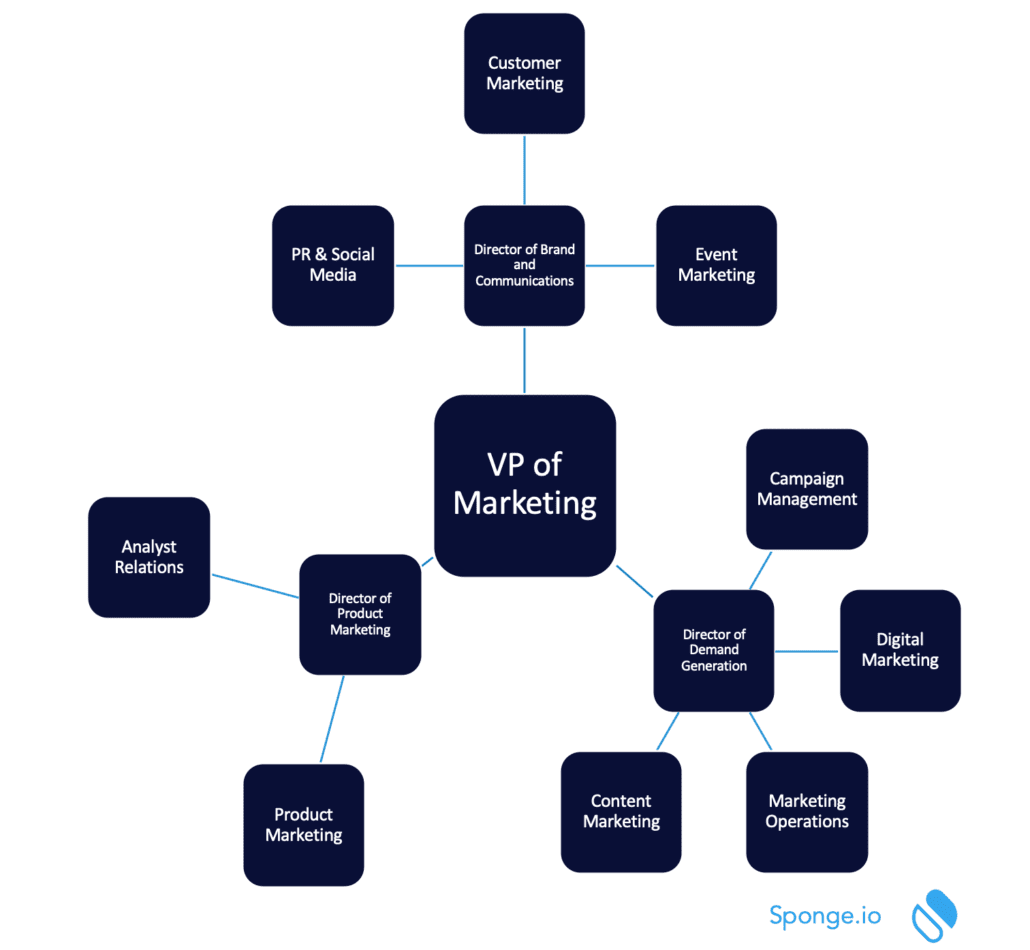
I’ve organized the team into three groups: 1) brand, 2) demand generation, and 3) product marketing. Each group is led by a Director, and the whole team is led by the CMO or VP of Marketing. This marketing team is comprised of the following 13 roles:
- VP of Marketing
- Director of Brand & Communications
- PR & Social Media Manager
- Customer Marketing Manager
- Marketing Events Manager
- Director of Demand Generation
- Marketing Campaigns Manager
- Digital Marketing Manager
- Marketing Operations Manager
- Content Marketing Manager
- Director of Product Marketing
- Product Marketing Manager
- Analyst Relations Manager
B2B Marketing Leadership Roles and Responsibilities
Let’s start at the top. Here’s what the VP of Marketing and each Director on the team is responsible for.
CMO/VP of Marketing
Your VP of Marketing is responsible for the company’s overall marketing strategy. That includes messaging, campaigns, and metrics. This person hires the talent that will execute on the marketing plan, and they’re a member of the executive team.
This is a key hire, so this person should have the right skills to fit your organization.
Do you need to grow revenue? Then you need to hire someone with a strong demand generation background. Are you having trouble telling your company story? Then you need to hire someone with a strong background in product marketing. Do you need to modernize your look & feel? Then look for someone more brand-oriented.
Someone once told me that when you’re recruiting a VP of Marketing, you’re looking for a mix of three skills – brand, demand generation, and product marketing – but you only get to pick two. It’s very rare to find all three in one person, so you’ll need to decide what’s most important for your company at its current stage.
Key Roles and Responsibilities:
- Create, communicate, and execute the company’s marketing strategy
- Support Sales through comprehensive demand generation programs. This may or may not include management of the business development team
- Craft the company’s story. Manage consistent communication of the marketing message with press, analysts, and the market at large
- Own the company’s brand, including the look & feel of all branded assets and web properties, as well as any content or touch points along the buyer’s journey
- Manage the marketing budget to ensure efficient spend across programs
- Develop quantifiable objectives, and measure results and ROI
Director of Brand & Communications
The Director of Brand & Communications is your brand champion. They’re creative, have a strong eye for design, focus on the big picture, and manage major projects with a lot of stakeholders. They’re also a bit of a stickler – that’s a good thing, because you need someone bullish to set brand standards and push the rest of the org to be consistent. This person also works closely with the VP of Marketing to formulate the marketing message, then translates that into the corporate website, press relations, and other corporate comms within their domain.
Key Roles and Responsibilities:
- Work with internal stakeholders to formulate the company story and craft messaging in response to new competitive positioning, product releases, etc.
- Manage the corporate website to present the marketing message in a visually compelling way (usually in conjunction with an agency for development support)
- Expand company awareness through the press, social media, and events
- Own the consistency of all touch points along the buyer’s journey, with a particular focus on customer engagement and happiness
Director of Demand Generation
The Director of Demand Generation is where the rubber hits the road for Sales. They’re energetic, analytical, ruthlessly efficient, and detail-oriented. This person is a truth teller and relies on data to make decisions, but they can build great relationships with Sales and push back on dumb ideas. Ultimately they have to have a service orientation to support Sales. This person owns the plan, execution, and analysis of all marketing campaigns that generate leads and opportunities, and works closely with Sales to ensure leads are followed up with promptly.
Key Roles and Responsibilities:
- Plan and execute demand generation campaigns across all channels – email, paid search, display advertising, content syndication, social, etc.
- Own the marketing prospect database. Improve the size and quality of contacts to support future marketing campaigns
- Analyze campaign effectiveness and maximize marketing ROI
- Manage the marketing automation system and its integration with the CRM to ensure the right information is captured to hand off leads to Sales and attribute campaign success
- Own the content calendar to support demand generation efforts across channel
Director of Product Marketing
The Director of Product Marketing ensures the company’s products and services resonate with the target market. They’re highly intelligent, creative, strategic thinkers who can translate convoluted technical concepts into easy-to-understand frameworks. They’re the “thought leaders” of the organization, in that they’re generating the “thoughts” that the rest of the marketing team will distribute inside and outside the company. They interface directly with clients and report back to product management, monitor the competitive landscape and marketing trends, and own the ever-misunderstood discipline of sales enablement.
Key Roles and Responsibilities:
- Plan product launches for all new products and releases, and coordinate with Product Management, Marketing, and Sales to execute a successful launch
- Conduct regular, in-depth competitive analysis so marketing and Sales can speak more credibly with prospects
- Develop all sales tools, including value propositions, competitive positioning, launch scripts, customer proof points, ROI metrics, and calculations
- Develop thought leadership for use in bylines, corporate messaging, and other content
Brand & Communications Team Structure
Led by the Director of Brand & Communications, this team includes three roles: PR & Social Media, Customer Marketing, and Marketing Events. Branding is important because it’s how your company is perceived in the market. You need one or two clear strategies for how you want to brand your company, then execute those strategies flawlessly – someone should be able to see a post from your company and immediately recognize it from the coloring and style alone. Here’s who makes that happen day to day.
PR & Social Media Manager
Social media is a strong marketing tool used in both B2B and B2C industries. For B2B companies, an active, consistent social presence builds credibility with buyers and keeps your brand top of mind.
Key Roles and Responsibilities:
- Building and managing company social media presence across appropriate channels, including LinkedIn, X, and Facebook
- Generating engaging content for followers to like and share, and growing the company’s following
- Monitoring social media activity and responding promptly to consumer issues and concerns in an appropriate manner
- Identifying social campaigns aimed at engaging the target market to produce prospective leads
- Working strategically with other marketing team members to promote their campaigns through social channels
Customer Marketing Manager
Your existing customers are your best source of growth and proof. The Customer Marketing Manager turns happy customers into advocates through references, case studies, reviews, and community programs, and drives expansion through upsell and cross-sell campaigns.
Key Roles and Responsibilities:
- Building customer advocacy programs, including references, case studies, testimonials, and reviews
- Running customer communications such as newsletters, product updates, and user events
- Partnering with Customer Success and Sales on retention, upsell, and cross-sell campaigns
- Measuring customer engagement, advocacy participation, and expansion pipeline
Marketing Events Manager
Your events marketing manager is in charge of determining which public and private events your company should be involved with, and making sure the company is well represented at those events. This person has great people skills and always seems to meet the important people. They drive growth for the company through attending the right events and interacting with prospective clients – much of the job is identifying leads and qualifying them quickly for the sales team.
Key Roles and Responsibilities:
- Identifying both public and private events in the community to attend, to promote brand awareness and product demand
- Communicating, maintaining, and developing strong client relationships
- Keeping projects on budget and on schedule for delivery with little to no issues
- Ensuring the marketing message is clear and well represented at events by current and prospective clients
Demand Generation Team Structure
Led by the Director of Demand Generation, this team includes four roles: Marketing Campaigns, Digital Marketing, Marketing Operations, and Content Marketing. This is the team responsible for getting customers in the door. It owns the campaigns, channels, systems, and content that turn prospects into pipeline.
Marketing Campaigns Manager
Marketing campaigns are how you turn a list of names into a pipeline. The Marketing Campaigns Manager owns that process end to end – building the database of prospects, then engaging and nurturing those leads at the right cadence as they move through the funnel. This is trickier than it sounds: too much contact and leads unsubscribe, too little and they feel unwanted and drop out of the funnel altogether. This person has to be part database steward, part campaign strategist, and part analyst, always tuning the mix based on what the numbers say is working.
Key Roles and Responsibilities:
- Building and growing the company’s database of sales leads, including name, company, title, and contact information
- Automating the marketing campaign process to engage with and nurture leads as they progress through the sales funnel
- Managing and designing email, blog, webinar, and other campaigns in collaboration with other in-house marketing team members
- Measuring and reporting on key metrics from campaigns, such as open rate, conversion rate, and MQL volume
Digital Marketing Manager
Once your company has enough scale, it’s time to shift your marketing approach from purely outbound to a more inbound strategy – which requires a full-time position: the Digital Marketing Manager.
Key Roles and Responsibilities:
- Generating engaging content and posting frequently
- Building demand through content that grows the company’s prospective leads list
- Automating marketing strategies to ensure productivity across channels, including social, email, and blog
- Optimizing conversion rates through CTAs and landing pages
Marketing Operations Manager
Marketing operations managers are the Swiss Army knife of the marketing team. They can do a little bit of everything, moving back and forth between the creative and analytical sides. The main goal for a Marketing Ops Manager is to measure the ROI of all marketing activities – and to serve as the liaison between marketing and sales, ensuring a cohesive message throughout the sales process.
Key Roles and Responsibilities:
- Managing the CRM and marketing automation platforms used by marketing and sales (i.e., Salesforce, HubSpot, Marketo)
- Establishing and maintaining a strong line of connection between key marketing and sales team members
- Creating and maintaining metrics reports on marketing and sales activities, effectiveness, and business impact
- Analyzing marketing and sales data to develop insights and recommendations for optimization
- Monitoring and maintaining data quality within the marketing database
Content Marketing Manager
Content is the fuel that drives your marketing campaigns. You need someone whose job it is to create the best content for your marketing efforts – you need a Content Marketing Manager.
Key Roles and Responsibilities:
- Creating marketing resources each month to drive metrics such as leads, subscribers, and brand awareness
- Consistently blogging to attract site visitors through search, social media, and email subscribers
- Growing the subscriber base by releasing regular, helpful content aligned with audience needs and interests
- Collaborating with the internal marketing team, and external influencers and industry experts, to produce content that meets the needs of both key stakeholders and the audience
Product Marketing Team Structure
Led by the Director of Product Marketing, this team includes two roles: Product Marketing and Analyst Relations. This team is responsible for getting customers the right products, with the right message, at the right time.
Product Marketing Manager
The Product Marketing Manager works with both the marketing and sales teams to ensure a fluid, consistent message is relayed to the customer. One of the main activities for this role is determining the value proposition for a product and how it’s incorporated into the marketing message. Possibly the largest task, though, is understanding the company’s customers – the Product Marketing Manager is responsible for developing buyer personas for the company.
Key Roles and Responsibilities:
- Developing product positioning and messaging that differentiates the company’s products in the market
- Developing and communicating the value proposition of products to the sales team, to keep the marketing message consistent
- Planning the launch of new products and releases while managing cross-functional implementation of the plan
- Understanding customer personas and their needs through research, direct observation, and conversations
Analyst Relations Manager
The Analyst Relations Manager is responsible for facilitating regular contact with the analyst community, driving strategic analyst relations programs, and collaborating with sales, marketing, product management, and company executives to engage analysts on new product enhancements, company news, and strategic initiatives.
Key Roles and Responsibilities:
- Working with product marketing to secure positive analyst reports and deliver quality information to analysts
- Working with analyst firms to complete research reports and whitepapers
- Preparing analyst briefing tours, presentations, and documents
- Overseeing budget, analysis, and recommendations for purchased analyst research services
- Supporting the communications team on other PR-related programs and activities
Building Your Own Perfect Marketing Team
There is no “one-size-fits-all” for the perfect marketing team – there are too many variables, like company size and stage, industry, and go-to-market strategy. Having said that, we believe this is a highly effective structure, and most companies can benefit from it. Of course, you need to find the right people to fill these positions – but if you can, you’re well on your way to building the perfect marketing team.
FAQ
What’s the ideal size for a B2B marketing team?
There’s no universal number – it depends on revenue stage, industry, and go-to-market motion. The 13-role structure outlined above is built for a company scaling from roughly $10M to $40M+ in revenue. Earlier-stage companies, on the other hand, often combine several of these roles into one person – for instance, a single “growth marketer” covering campaigns, digital, and content. Then, as the team grows, they gradually split these responsibilities out into dedicated roles.
Do I need all three Director-level roles (Brand, Demand Gen, Product Marketing)?
Not necessarily, and certainly not all at once. In fact, most companies hire directors incrementally, adding each one as gaps become painful. Typically, Demand Generation comes first, since it’s most directly tied to pipeline and revenue. Next, Product Marketing follows as the product line matures. Finally, Brand & Communications rounds out the team once the company has enough visibility to protect.
Should the VP of Marketing come from a brand, demand gen, or product marketing background?
Whichever skill set most closely matches your company’s current gap. A VP of Marketing typically brings deep strength in two of the three (brand, demand gen, product marketing) and leans on directors to cover the third. If you’re struggling to grow revenue, prioritize demand gen experience. If your story isn’t landing, prioritize product marketing. If your brand feels dated or inconsistent, prioritize brand.
What’s the difference between Demand Generation and Digital Marketing?
Demand Generation is the strategic owner of the pipeline – planning and analyzing campaigns across every channel and owning the prospect database. Digital Marketing is more channel-specific, focused on inbound tactics like content, SEO, and landing page optimization. In smaller teams, one person often does both; in larger teams, Digital Marketing reports up through Demand Generation.
Who should own reporting on marketing ROI – Marketing Operations or the VP of Marketing?
Marketing Operations should own the mechanics: building the reports, maintaining data quality, and analyzing campaign and funnel performance. The VP of Marketing owns the narrative – translating that data into a story about ROI and strategy for the executive team and board. Think of Marketing Ops as the source of truth, and the VP as the one who contextualizes it.