A/B testing is one of the most effective tools available to email marketers. It helps remove guesswork, validate assumptions, and improve performance over time.
At the same time, email does not exist in isolation.
Most email campaigns are part of a larger experience that includes landing pages, pop ups, sales emails, and even social touchpoints. Strong testing programs recognize this and focus first on email marketing, then extend learnings into adjacent channels.
This post focuses primarily on A/B testing for email marketing, with guidance on how and when to apply similar testing principles across landing pages, pop ups, social, Salesloft, and Outreach.
Start With the Problem You Are Trying to Solve
Before testing anything, get clear on the outcome you care about most.
In email marketing, testing usually ties back to one of three pain points:
- Low open rates
- Low click-through rates
- Low conversion rates
Each of these points to a different part of the email experience and suggests different testing priorities.
For example:
- Open rate issues often point to subject lines, sender name, or timing.
- Click issues usually relate to layout, CTAs, copy structure, or visuals.
- Conversion issues may indicate friction beyond the email itself, such as landing page alignment.
Naming the problem upfront prevents unfocused testing and helps you choose the right channel to test in.
Define Success Before You Launch the Test
A/B tests should never be evaluated retroactively.
Before sending, define:
- The primary KPI for the test
- What success looks like
- How long the test will run
In email marketing, the most common KPIs are:
- Open rate
- Click-through rate (CTR)
- Conversion rate (CR)
CTR measures how many recipients clicked relative to how many opened. Conversion rate measures how many recipients completed the desired action. These metrics are related but not interchangeable.
Choose the metric that aligns with the pain point you are solving.
High-Impact A/B Tests for Email Marketing
Email is often the best place to start testing because changes are relatively easy to implement and results come quickly.
Subject Lines
Subject line testing directly impacts opens and is often the fastest way to identify lift.
Variables to test include:
Length
- Short and punchy, around 3 to 5 words
- More descriptive, around 7 to 10 words
Tone
- Conversational: “Glad You Could Join”
- Professional: “Register for Our Upcoming Webinar”
Personalization
- Including a first name or company
- Generic messaging
Numbers
- “5 Ways to Improve Team Efficiency”
- “Improve Team Efficiency”
Call-to-Action (CTA)
Once someone opens the email, the CTA becomes the primary driver of clicks.
Effective CTA tests include:
Placement
- Above the fold
- Below the fold
Format
- Button
- Hyperlinked text
Wording
- Direct: “Start Your Free Trial”
- Urgency-focused: “Claim Your Spot”
Color
- High-contrast colors
- Brand-aligned tones
Visual Content and Format
Visual decisions often affect scannability and engagement.
Tests to consider:
- HTML emails versus plain-text-style emails
- Static images versus animated GIFs
- Including a video thumbnail versus no video
- Image-based headers versus text-only headers
These tests are especially useful when open rates are healthy but clicks are lagging.
Email Layout and Readability
Small layout changes can make a big difference.
Variables worth testing include:
- Single-column versus multi-column layouts
- Short emails under 150 words versus longer formats
- Use of bullets and bolding versus paragraph-heavy copy
- Larger font sizes (14–16px) versus standard text
>Related: What is the Best Time to Send a Marketing Email?<<
When Email Testing Points Beyond the Inbox
Sometimes email performance issues are not caused by the email itself. That is when extending A/B testing to connected channels becomes important.
Landing Pages
If emails are generating clicks but conversions are low, the landing page is often the bottleneck.
Landing page tests may include:
- Placement of copy, imagery, and forms
- Long-form versus short-form pages
- Button copy and color
- Adding or removing social proof
Email and landing page tests should be reviewed together whenever possible.
Pop Ups
Pop ups frequently support email campaigns by capturing leads or reinforcing offers.
Common tests include:
- Background color
- Button color
- Trigger timing
- CTA language
- Linking to a landing page versus embedding a form
Pop up testing is most effective when aligned with active email campaigns rather than run in isolation.
Salesloft and Outreach Emails
While marketing and sales emails serve different purposes, testing principles still apply.
Tests to consider in Salesloft or Outreach include:
- Plain text versus lightly formatted emails
- Subject line length and style
- CTA language
- Referencing recent engagement or activity
- Email timing within sequences
These tests tend to work best when marketing and sales teams align on messaging and goals.
Social Channels
Email insights can often inform social testing.
For example:
- Subject line language can inspire post headlines
- High-performing CTAs can be reused in social copy
- Visual styles that drive clicks in email may also work well on LinkedIn
Social testing does not need to mirror email testing exactly, but patterns often translate.
How to Structure an Effective A/B Testing Plan
Strong testing programs are simple and repeatable.
Start small by testing one element per campaign so results are clear.
Define KPIs in advance and use control groups when possible, especially when testing against an existing high-performing format.
Most importantly, plan for what happens after the test. Document results, share learnings, and apply winners consistently. Testing without implementation does not create value.
Final Thoughts
Email marketing should be the foundation of most A/B testing programs. It is measurable, flexible, and closely tied to business outcomes. From there, extending testing to landing pages, pop ups, sales emails, and social channels helps ensure the entire journey is optimized, not just the inbox experience.
The most effective testing programs focus on solving real problems, stay disciplined about measurement, and evolve over time. Email is where that discipline usually starts.
FAQ
What is A/B testing in email marketing?
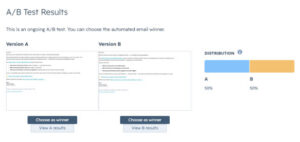
A/B testing, also called split testing, means sending two versions of an email to different segments of your audience to see which one performs better against a specific metric, such as open rate, click-through rate, or conversion rate. The winning version informs how future campaigns are built.
How long should an email A/B test run?
Most email tests need at least 24 to 48 hours to gather enough opens and clicks for a reliable read, though the exact window depends on your list size and how quickly your audience typically engages. Define the test length before launch rather than cutting it short once one version pulls ahead.
How large does my list need to be to get valid results?
There is no universal minimum, but smaller lists need larger performance gaps before a result is meaningful. As a general rule, each test variant should reach at least a few hundred recipients. If your list is small, consider running the test over a longer period or focusing on higher-impact variables where differences are easier to detect.
Should I test one email element at a time or several at once?
Test one element per campaign whenever possible. Changing the subject line, CTA, and layout all at once makes it impossible to know which change drove the result. Isolating variables takes more tests over time, but each result is clear enough to act on with confidence.
How is testing email different from testing landing pages or pop ups?
The core testing principles, such as isolating one variable and defining success in advance, carry over across channels. What changes is the metric you are optimizing for. Email tests usually center on opens and clicks, while landing page and pop up tests center on conversions and form completions. Reviewing results across channels together, rather than in isolation, gives the clearest picture of where the journey breaks down.
What should I do after an A/B test ends?
Document the result, note what you learned, and apply the winning version to future campaigns. Testing only creates value when the findings get implemented and shared with the team, so build a simple habit of logging results somewhere everyone can reference before moving on to the next test.