How the three functions fit together, who owns what, and which one your team needs right now
Ask five revenue leaders to define revenue operations, and you’ll probably get five different answers. Some use “RevOps” as a new name for sales ops. Others treat it as a separate team that sits alongside marketing ops. The confusion matters, because it shapes who you hire, what they own and whether your marketing and sales data ever connect.
At Sponge, we think of revenue operations as the umbrella, with marketing operations and sales operations as two distinct functions underneath it. RevOps is what connects them, along with customer success operations, into one revenue engine.
In practice, there’s rarely a clean “versus” between these functions. Marketing’s results depend on sales ops and customer success, and sales depends on the leads and data marketing ops provides. The real question isn’t which team owns what, but how they work together.

Quick definitions
- Marketing operations (MOps) runs the systems and processes behind marketing: your marketing automation platform; lead capture, lead scoring, and lead management; campaign operations and attribution logic; data quality and enrichment; and marketing reporting. Its job is to make marketing efficient and measurable.
- Sales operations (Sales Ops) runs the systems and processes behind selling: your CRM, territories and lead routing, pipeline management, forecasting, quoting, and sales reporting. Its job is to help reps sell more efficiently.
- Revenue operations (RevOps) connects marketing, sales and customer success around shared data, shared definitions and shared goals. Its job is to make the whole funnel work as one system, from first touch to renewal.
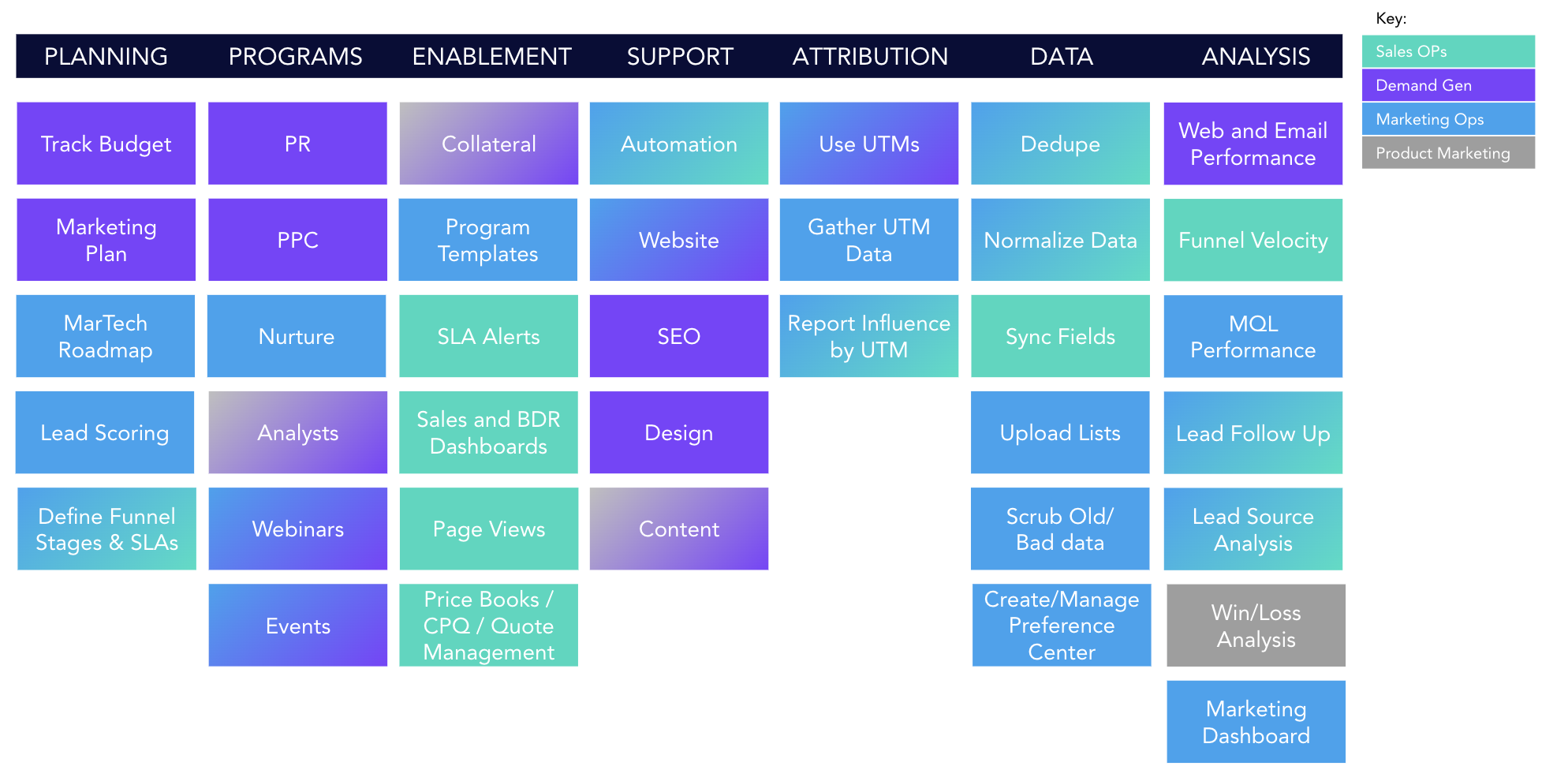
How they Compare
| Marketing ops | Sales ops | Revenue ops | |
|---|---|---|---|
| Scope | Marketing | Sales | Marketing, sales and customer success |
| Typically reports to | CMO | VP of Sales or CRO | CRO, COO or CEO |
| Core systems | Marketing automation (Marketo, HubSpot, Pardot), forms, enrichment | CRM (Salesforce, HubSpot, Dynamics), sales engagement, CPQ | The full revenue stack, and how its parts connect |
| Typical work | Lead scoring, nurture programs, campaign setup, attribution, data hygiene | Routing, territories, pipeline stages, forecasting, quoting | Funnel definitions, SLAs between teams, end-to-end reporting, revenue planning |
| Key metrics | MQLs, conversion rates, cost per lead, marketing-sourced pipeline | Win rate, sales cycle length, quota attainment, forecast accuracy | Pipeline velocity, funnel conversion from lead to revenue, revenue growth |
Where the handoffs happen
The hardest problems usually live between teams, not inside them. Marketing ops often owns a lead until it becomes an MQL, and sales ops takes over once a rep accepts it. In between sit the questions no single team owns:
- What counts as an MQL, and who agreed to that definition?
- How fast should sales follow up, and what happens when they don’t?
- Which source gets credit when a deal closes?
- Why don’t marketing’s and sales’ reports match?
That’s where revenue operations earns its place. RevOps defines the lifecycle stages both teams use, sets SLAs at every handoff and builds reporting that follows a lead from first touch to closed deal. For a practical example, see how to build a lead-to-revenue model.
Marketing ops and sales ops also need to share the same definitions, fields, dashboards and SLAs, which is why on smaller teams the two roles are often combined into a single hire. For a practical framework, including the master spreadsheet we recommend both teams maintain together.
>>Related: Roles and Responsibilities: MOPs vs Sales Ops vs Demand Gen<<
Signs you need each one
You need stronger marketing ops if:
- Your marketing automation platform is cluttered with old programs and inconsistent data
- You can’t tell which campaigns generate pipeline
- Lead scoring is missing, or nobody trusts it
You need stronger sales ops if:
- Leads sit unassigned, or reps fight over accounts
- Pipeline stages mean different things to different reps
- Forecasts regularly miss
You need revenue operations if:
- Marketing and sales report different numbers for the same funnel
- Leads fall through the cracks between teams
- Leadership can’t see the full path from lead to revenue in one places
How most teams evolve
You don’t need three separate teams on day one. Most growing companies follow a similar path:
- Early stage: one person, often in marketing, handles the marketing automation platform and CRM. Ops is part of someone’s job, not a function.
- Growth stage: marketing ops and sales ops become separate roles, each focused on its own systems. This is often when handoff problems appear.
- Scale stage: a RevOps leader brings the functions together under shared definitions, shared reporting and a single plan, often reporting to a CRO or COO.
Many teams in the growth stage need RevOps thinking before they can justify a full RevOps team. That’s where fractional support helps: experienced operators who can set up shared definitions, SLAs and reporting across marketing and sales, for a set number of hours each week. (Read more about what to expect from fractional marketing ops.)
FAQ
Is RevOps just a new name for sales ops? No. Rebranding sales ops as RevOps without changing its scope misses the point. Revenue operations spans marketing, sales and customer success, while sales ops focuses on the sales team’s systems and processes.
Does revenue operations replace marketing operations? No. In most companies, marketing ops continues to run the marketing systems, while RevOps connects them with sales and customer success. Think of RevOps as the umbrella, with marketing ops and sales ops underneath it.
Who should RevOps report to? Usually a CRO, COO or CEO, since RevOps spans several departments. Reporting to a single department head, like the VP of Sales, can make it hard to stay neutral between teams.
When should a company invest in revenue operations? When marketing and sales numbers stop matching, leads fall through the cracks between teams, or leadership can’t see the full funnel in one place. Those are signs the handoffs need an owner.
Can one team handle marketing ops and sales ops? Yes, especially at smaller companies. The key is clear definitions and SLAs for each stage, so one team can manage both sides without blurring who owns what.
Need help connecting your marketing and sales operations? Explore our fractional marketing and revenue operations services, or book Office Hours with a senior Sponge consultant.